Junior Vacation.
Yellowstone, United States
United States

Yellowstone with kids.

Yellowstone with kids isn't a trip to a park. It's a planning operation that starts 13 months out, runs across two or three lodges, and ends with kids who suddenly know what a bison sounds like up close.

Best for All ages, with a real sweet spot at 4-8Old FaithfulwildlifeLamar ValleyGrand Canyon of the Yellowstone
Best for ages
All ages, with a real sweet spot at 4-8
Best time to visit
Mid-June through mid-July or early September. Skip late July-August (peak crowds, heat, parking lots full by 10am). Late September is the under-the-radar pick — better wildlife, lower prices.
How long to stay
5-7 nights inside the park; add 2-3 nights for Grand Teton if you're combining the two

Yellowstone isn't really a park you visit. It's a 2.2-million-acre planning operation with a name. Reservations open 13 months ahead. The food is bad. Parking lots fill by 10 a.m. all summer. There's no cell service except in four specific spots. And if you pick one lodge and try to base there for the whole week, you'll spend half the trip in the car driving 90 minutes back to your room.

That's the part nobody tells you on the postcards.

The other part is that it's worth all of it. Kids who saw bison up close still talk about it three years later. The 4-year-old who can't remember her own birthday remembers the geyser that went off while she was eating a sandwich. The 8-year-old comes home asking when you're going back.

So the trip needs a plan. Four days minimum (five is better). Two in-park bases instead of one. A cooler in the car. Bear spray you'll never use. A free Junior Ranger booklet. And — this one's not optional for the under-fives — a harness with a leash for the boardwalks, because the water is literally boiling and the railings stop where the steam starts.

Yellowstone with kids: what changes by age band

Yellowstone fit changes dramatically by age. A trip with a 1-year-old, a 5-year-old, and a 10-year-old are three different vacations. What works for one age genuinely breaks for another.

With a baby (under 2)

Yellowstone with a baby is doable. It's also a trip for you, not for them. They won't remember the bison. They won't remember the geyser. They won't remember any of it. If you're going so the older sibling has the memory and the family has the photos, do it. If you're going for the baby's sake, wait.

What works at this age: a hiking carrier (not a stroller — most trails don't allow wheels), one feature per morning, a nap-drive mid-day, and back to the hotel by 4 p.m. Mammoth Hot Springs Hotel & Cabins is the best in-park base for this band — the cabin oval has a grassy middle for crawling. The Old Faithful boardwalk is stroller-friendly. The Lamar Valley is not — skip it with a baby under 1.

The honest piece: babies cry above 6,000 feet sometimes. Yellowstone runs 6,000-8,000 ft. The first night is the worst. Hydrate everyone aggressively, accept a rough sleep, and the second night usually fixes itself.

  • Hiking carrier (Osprey Poco or similar), not a stroller — strollers OK on boardwalks but banned on real trails
  • Mammoth cabins (grassy oval) > Old Faithful Inn Old House (thin walls, no AC, shared baths)
  • One feature per morning; nap-drive mid-day; back to the room by 4 p.m.
  • Skip Lamar Valley dawn drives — Hayden Valley near Canyon does the bison job
  • Altitude 6,000-8,000 ft: first night is rough, hydrate aggressively
  • Slumberpod + travel crib if your baby sleeps better in dark

With a toddler (2-3)

This is the hard band. A 2-year-old at a geyser boardwalk is a 2-year-old who wants to run, and the water is 200°F, and the railings don't go all the way around. Parents on r/Yellowstone are blunt about this: "we saw soooo many wild kids running along the boardwalks that could have easily fallen in."

A harness with a leash is not optional. Use it on every boardwalk. Use it at every viewpoint. Use it when you stop the car for a bison. Veteran toddler parents say the same thing over and over: the harness is the difference between a great trip and a tragedy.

A hiking carrier still beats a stroller for the trails. Cap the day at one thermal basin plus one short walk. Pack three times the snacks you think you need. Don't try Lamar dawn unless you can sleep the toddler in the car at 5 a.m. A lot of veteran threads say the same thing: with a 2- or 3-year-old, wait a year. By 4 the trip is dramatically easier.

  • Harness with leash on every boardwalk — non-negotiable per parent consensus
  • Carrier > stroller for trails; stroller OK on boardwalks at Upper/Midway/Lower Geyser Basins + Mammoth lower terrace
  • Cap at 1 thermal basin + 1 short walk per day
  • Pack 3x the snacks you think you need
  • Skip Lamar Valley dawn drives; Hayden Valley near Canyon Lodge is enough
  • Bear spray on trails (not boardwalks); carry it, hope you never use it

Sweet spot (4-7)

This is the band Yellowstone is designed for. A 5-year-old can walk a 2.6-mile flat trail to Lone Star Geyser, sit through the Old Faithful wait, fill out the Junior Ranger booklet, and remember every bit of it well enough to tell their teacher about it.

Real hikes become possible. Storm Point (3 miles, marmots at the halfway point) and Trout Lake (1.2 miles flat, otters) are both walkable. Mystic Falls works for 5+. Junior Ranger is the kid magnet — a $5 booklet, activities at every visitor center, a wooden badge at the end. It comes up in literally every parent thread.

The GuideAlong app earns its keep at this age. Drives between attractions stop being kid jail and start being educational time. Kids in the back seat hear the audio tour and start asking "what's the white stuff on the rocks?" before you do. Canyon Lodge is the ideal base — central, has actual food, other families everywhere, walking trails out the door.

  • Junior Ranger booklet (free at any visitor center, wooden arrowhead badge on completion)
  • GuideAlong app — universal parent-forum recommendation, ~$20 one-time for the Yellowstone tour ($30 season pass covers Yellowstone + Grand Teton), narrates drives
  • Storm Point + Lone Star Geyser + Trout Lake all walkable at this age
  • Canyon Lodge ideal base; split with Old Faithful for 1-2 nights
  • Old West Dinner Cookout at Roosevelt — wagon (all ages, under-3s ride free on a lap), horseback 8+, books 13 months ahead
  • Old Faithful eruption 14-minute viewing fits the attention span

8-12

At 8 the park opens up. Real hikes — Mystic Falls, Fairy Falls + Grand Prismatic Overlook, Bunsen Peak with a snack-bribery summit. Yellowstone River rafting out of Gardiner becomes a trip highlight ("10/10 experience for the kids," one parent put it). Lamar Valley dawn drives become their obsession instead of yours.

This is also the age that handles the long days. Two-park days. Five hours in the car if it's chasing wolves. Closing out the geyser basin at sunset.

Old Faithful Inn becomes legitimately interesting too — the lobby, the string quartet on summer evenings, the deck with the geyser view at breakfast. It's still a 1-star room. The bluntest parent take going around: "This is a 1 star hotel in a 5 star location." Book it for one or two nights, eat breakfast on the deck watching geysers, then sleep at Canyon for the rest of the week.

  • All kid hikes open up: Mystic Falls, Fairy Falls + Grand Prismatic Overlook, Bunsen Peak
  • Yellowstone River rafting out of Gardiner: scenic float 6+, whitewater 8+
  • Lamar Valley dawn drives — leave 4:30 a.m. from Mammoth or Roosevelt
  • Old Faithful Inn 1-2 nights becomes worth it for the lobby + deck breakfast
  • External battery pack — the no-cell-service reality drains the phone fast

Teens

Teens handle the whole park. Add Grand Teton (Jenny Lake shuttle + Hidden Falls, Cascade Canyon, kayaking) as 2-3 days at the end. Add Cody for a rodeo night if you're flying in via the east entrance. Don't overschedule — let them have a half-day at the hotel pool or the West Yellowstone general store.

The phone reality matters at this age. Almost no cell service inside the park. Download GuideAlong offline before you arrive, download Google Maps offline, accept that the family group chat goes dark for a week. Most teens come out the other side fine. The first 24 hours are the rough ones.

  • Grand Teton 2-3 nights at the end (Jenny Lake, Cascade Canyon, Jackson aerial tram)
  • Cody rodeo (nightly June-Aug) if east-entrance routing
  • Download GuideAlong + Google Maps + Spotify playlists offline before arrival
  • Accept the phone goes mostly dark inside the park
  • Adventures by Disney Wyoming itinerary if you'd rather book the planning (min age 4, recommended 7+)

What to actually do in Yellowstone (area by area)

Yellowstone breaks into six rough zones. Each one is its own day or half-day. Trying to do all six in three days is the #1 mistake forum veterans flag.

Old Faithful & the geyser basins

Upper Geyser Basin — west side of the park · Best for All ages; the geyser area works at every age

Old Faithful itself is the headliner, but the area is a half-day to a full day if you do it right. Eruptions run on a roughly 90-minute cycle. Predictions are posted inside the Old Faithful Visitor Education Center and on the NPS app. Get there twenty minutes early for a bench seat with a clear view; the back of the crowd misses the start.

The under-discussed move: walk past Old Faithful itself to the boardwalk loop. Castle, Grand, Daisy, Riverside, and Morning Glory Pool are all within a 2-mile flat boardwalk loop. The kids who get bored with Old Faithful re-engage at Castle Geyser. Bring water; the basin is exposed and treeless.

Old Faithful Inn breakfast on the deck is the operational hack nobody else publishes. Order to go from the dining room, walk out to the deck, and watch a couple of eruptions while you eat. The Old Faithful Lodge has cheap food and an ice cream shop on the way out.

Order breakfast to go in the morning and sit on the deck to watch the geysers!
a parent blog (Everyday Adventure Family)

Tip: Eruption predictions are posted inside the visitor center + on the NPS app. Arrive 20 min early for a bench seat.

Skip note: Skip the front-of-crowd selfie spot — the rangers gently move you back. Plenty of better viewpoints along the boardwalk.

Grand Canyon of the Yellowstone

Canyon Village area — east-central park · Best for 5+ for the lookouts; 8+ for the stair-heavy trails

This is the place that surprises parents. The canyon is 24 miles long, 1,200 feet deep, and the lower falls drops 308 feet — twice the height of Niagara. One blogger described looking out from Artist Point and "becoming aware that I was crying." It hits like that.

Artist Point is the iconic shot. Lookout Point gives you the same falls from a different angle. Inspiration Point and Grand View are on the North Rim Drive; South Rim has Artist Point. Drive both rims; the canyon looks different from each side.

Plan this for a "soft" day, not after a 6 a.m. Lamar drive. Kids who are already wrecked from wildlife dawn-watching will miss the moment.

I simply became aware that I was crying.
a parent blog (Dirty Feet Diaries)

Tip: Drive both rims — the canyon looks different from each side. Artist Point and Lookout Point are 10 min apart.

Skip note: Plan this for a soft day — kids who are already wrecked from a dawn wildlife drive will miss the moment.

Lamar Valley

Northeast corner — between Tower-Roosevelt and the NE entrance · Best for 6+ for dawn wildlife drives; under-6 should go to Hayden Valley instead

The Serengeti of North America. Bison herds in the hundreds. Wolves on a good morning. Black bears and the occasional grizzly. Eagles, pronghorn, coyotes, sometimes a moose.

The catch: you need to be there at dawn or dusk. Animals bed down midday. From West Yellowstone or Old Faithful, dawn at Lamar means leaving at 4 a.m. From Mammoth or Roosevelt, it's a 45-minute drive at 5 a.m. — much more humane.

For under-6 families, swap Lamar for Hayden Valley. Hayden runs from Canyon Lodge area to Yellowstone Lake — bison herds + grizzly chances + a 30-minute drive from your room instead of a 2.5-hour drive. The wolves are mostly Lamar, but bison are everywhere.

If you're serious about wolves, hire a guide. A few parents flagged the same surprise: kids pay attention to a guide they aren't related to. A few hundred dollars buys a spotting scope you don't have and a guide who knows where the wolves slept last night.

[Kids] listen significantly more intently to people who are not me.
a parent blog (West Family Travel)

Tip: Leave 4:30-5 a.m. from Mammoth or Roosevelt. From Old Faithful it's a 3-hour drive — skip Lamar that day.

Skip note: Skip Lamar with under-6s. Hayden Valley near Canyon gives you the bison fix on a 30-min drive.

Mammoth Hot Springs

Northwest park, 5 miles from Gardiner / north entrance · Best for All ages, but the terraces are seasonal

The travertine terraces are beautiful in spring and early summer when water is flowing. By August, large sections go dry and turn into pale-grey rock. One blogger called Mammoth in mid-September "largely dry" and disappointing. Don't anchor a trip on the photos you saw if you're coming in late summer.

What still works year-round: the historic Fort Yellowstone buildings (former Army cavalry post), the elk who lounge on the lawn between buildings like landscaping, the upper-terrace drive loop (kids stay in the car, see the formations through the window), and the Albright Visitor Center museum (a 90-minute rainy-day save).

Mammoth Hot Springs Hotel & Cabins is the best in-park base for Lamar-heavy trips. The cabin oval has a grassy middle where kids run while parents grill. The Mammoth Clinic is on-site — peace of mind with little kids.

The assigned cabins form an oval with a lawn in the middle where the kids liked to play with each other in the evening.
a parent on social media

Tip: If you're visiting Mammoth in August or September, manage expectations on the terraces. Lower-terrace boardwalk is short and stroller-friendly.

Skip note: Skip the upper-terrace hike if the lower terrace looks dry — odds are the upper is drier.

Grand Prismatic Spring

Midway Geyser Basin — south of Old Faithful · Best for Boardwalk: all ages. Overlook: 7+ for the 1-mile hike up

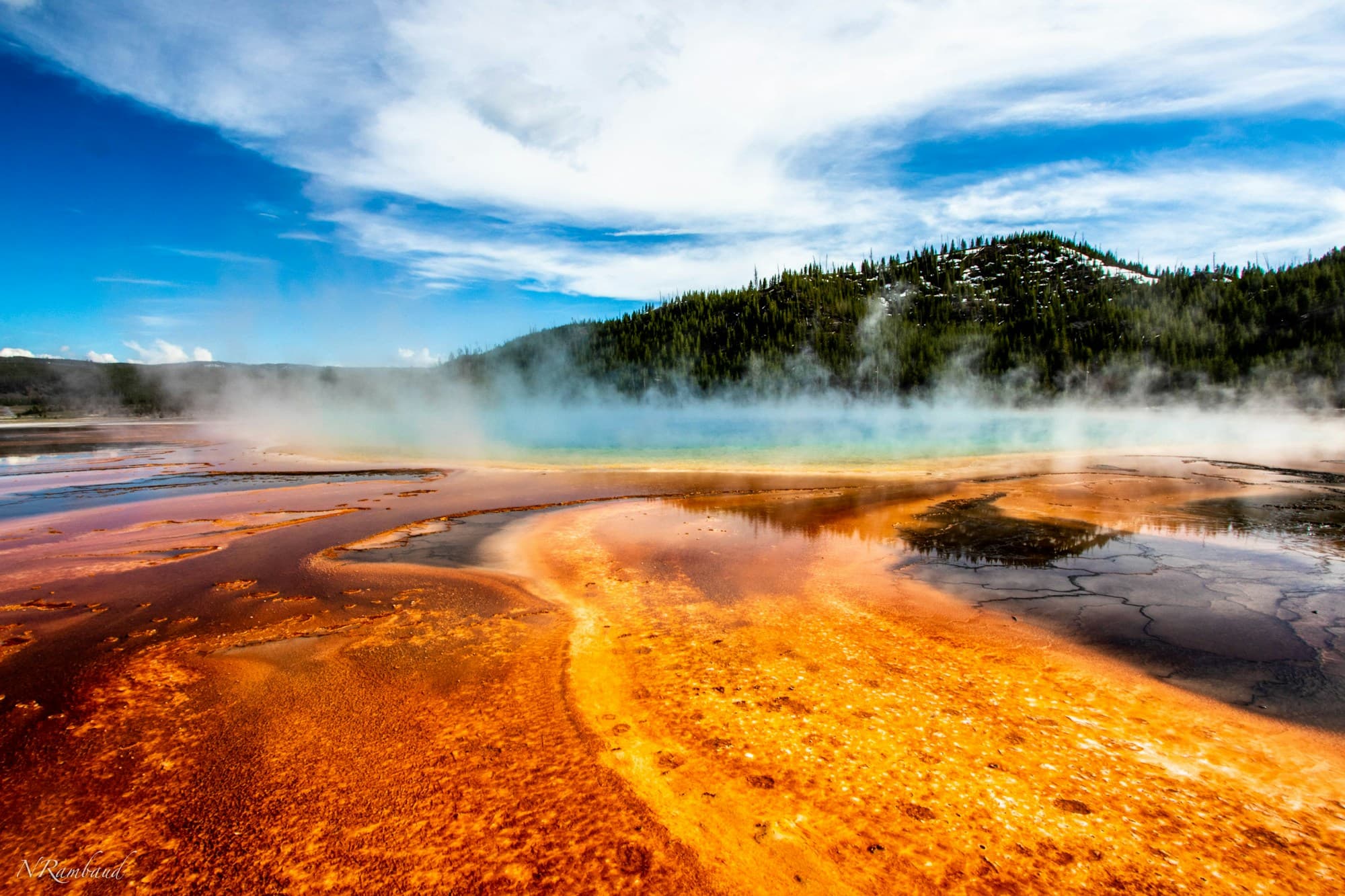
Two views, two experiences. The boardwalk takes you across the spring at ground level — you see steam, you smell sulphur, you might see the rainbow if the wind is right. The Fairy Falls overlook (a separate 1-mile trail uphill from the Fairy Falls trailhead) gives you the rainbow shot you've seen on Instagram. The overlook is the actual photo.

Most families do both. Boardwalk takes 30 minutes. Overlook is 45-60 minutes round trip. Combined visit: about two hours.

Parking at the main Grand Prismatic lot fills by 10 a.m. June through August. The Fairy Falls trailhead lot also fills. The move: arrive before 9 a.m. or after 4 p.m. The light is also better at those times.

Tip: Arrive before 9 a.m. or after 4 p.m. Both parking lots fill by mid-morning all summer.

Skip note: Skip the overlook with under-5s — it's a 1-mile uphill hike each way, no shade, and the toddler won't appreciate the photo.

Yellowstone Lake area

South-central park, accessed from Grant Village + Fishing Bridge · Best for All ages; the quietest half of the park

The under-discussed quiet half of the park. Yellowstone Lake is the largest high-elevation lake (above 7,000 feet) in North America. Storm Point Trail and Pelican Creek Nature Trail both run from the Fishing Bridge area — Storm Point is the better kid hike (2.3-mile loop, marmots at halfway). Mud Volcano + Dragon's Mouth Spring (sulfurous, dramatic, kids either love or hate it) are 15 minutes north.

Lake Yellowstone Hotel is a different lodging story than the rest of the park. The cottages are basic (small windows, no fridge), but the main hotel dining room is the best in-park meal you'll get. The move some veteran families make: sleep elsewhere, eat dinner here once.

It was hands down the best national park meal we had on this trip!
a parent blog (Everyday Adventure Family)

Tip: Eat dinner at Lake Yellowstone Hotel even if you're not sleeping there. Book a reservation 30-60 days ahead.

Skip note: Skip the Lake Lodge cottages if you have a baby — no fridge, small windows, employee-parking-adjacent.

Tower-Roosevelt area

Northeast park, between Mammoth and Lamar · Best for All ages, especially 4-10 for the Old West Dinner Cookout

The quiet northeast corner. Tower Fall is a 132-foot waterfall viewable from a short paved overlook a couple of minutes from the parking lot — the trail down to the base has been closed since rockslides in 2004, so manage kid expectations: it's a look-from-above stop, not a hike-to-the-falls. Calcite Springs Overlook (5 minutes south) is a tree-framed canyon view that's almost always uncrowded. Petrified Tree (a single ancient redwood stub) is a quick stop.

The headline here is the Old West Dinner Cookout. Wagon ride or horseback ride from Roosevelt Lodge out to a creekside cookout — steak, beans, apple betty, cowboy songs. The wagon takes all ages (under-3s ride free on a parent's lap); the horseback ride needs riders 8+. Books out 13 months ahead with the lodges. Worth booking the moment your dates open.

Roosevelt Roughrider cabins are nearby — rustic (some have no private bath), but the closest in-park base for Lamar Valley wolves.

Kids said the cookout was one of their favorite parts of their Yellowstone vacation.
a parent travel-forum review

Tip: Book the Old West Dinner Cookout 13 months ahead — slots open with the lodges on the 5th of the month.

Skip note: Don't book the cookout if you're based at West Yellowstone — you'll be driving home at night, which forum veterans flag as a hard no.

Kid-friendly hikes in Yellowstone

Yellowstone's hike landscape is bigger than the boardwalks suggest. These are the trails that come up across parent forums and family-travel blogs — sorted by age fit. Most families do two or three of these on a 5-day trip.

Storm Point Trail

Yellowstone Lake area, trailhead 3 miles east of Fishing Bridge · Best for 5+ (younger kids can do the out-and-back, not the full loop)

2.3-mile loop along Yellowstone Lake. Mostly flat. Lakeshore views, a section through lodgepole forest, and — the kid hook — a marmot colony at the halfway point. The marmots are tame enough that they sit on rocks while kids watch from a few feet away.

If the full loop is too long, do it as an out-and-back to the marmots and turn around (about 1.5 miles total). The trail commonly closes in late spring and early summer for bear activity — not bison, despite what older blog posts claim. Check at the Fishing Bridge Visitor Center the morning of your visit; the closures move week to week.

There is a marmot colony near the half way point.
a parent on a travel forum

Tip: Park at Indian Pond pullout, 3 miles east of Fishing Bridge. Trailhead is right there.

Lone Star Geyser

South of Old Faithful, off Grand Loop Road · Best for 3+ — flat trail, just long

The anti-Old-Faithful. Same geyser drama (eruptions every ~3 hours, 35-45 feet high, with preliminary minor eruptions leading to a main show that can last up to 30 minutes), no crowd. The 2.6-mile trail follows an old service road through the forest, flat the whole way. Kids 3+ can do it if you carry a snack.

The trade: you don't know exactly when the geyser will erupt. Check the small wooden logbook at the geyser when you arrive — visitors record eruption times, so you can estimate the next one. Worst case you wait 90 minutes for the show. Best case you arrive five minutes before. Either way, the kids have the geyser to themselves.

Sure enough, it did! We were so relieved, and it was incredible to watch. And you know what the best part was? We were the only ones there!
a parent blog (Restless Pursuits)

Tip: Check the logbook at the geyser. Visitors record eruption times so you can predict the next one within 30 min.

Trout Lake

Northeast park, Lamar Valley area · Best for 3+ (short, steep first 100 yards, then flat)

1.2-mile loop around a small lake in the Lamar Valley. About 200 feet of elevation gain — all in the first 100 yards. Once you're at the lake it's flat. Otters live here and are often visible scrambling across rocks. Watch the lake itself — cutthroat trout are visible from shore in late spring.

The trailhead is small and easy to drive past. Park near the small turnout 1.5 miles south of Pebble Creek Campground on the Northeast Entrance Road.

Trout Lake is my favorite escape. So quiet and you can watch otters scramble across rocks for hours.
a parent on social media

Tip: Trailhead is a small turnout 1.5 miles south of Pebble Creek Campground. Easy to miss.

Mystic Falls

Biscuit Basin, just north of Old Faithful · Best for 5+

2.4-mile out-and-back to a 70-foot waterfall, through the Biscuit Basin geothermal area. The trail starts on a boardwalk through the basin (steam, sulphur, kids stick to the boardwalk), then turns into a regular forest trail to the falls.

The geothermal opening means the kids see geysers and then go for a real hike right after — good combo. Mostly shaded, modest elevation. Pack the water; the boardwalk section gets hot.

Tip: Park at Biscuit Basin parking. Lot fills by 10 a.m. June-August.

Fairy Falls + Grand Prismatic Overlook

Just south of Midway Geyser Basin · Best for 7+ for the full distance; the overlook portion alone works for 5+

About 5 miles round trip if you do the whole thing (closer to 5.4 with the overlook side trip) — but the Grand Prismatic Overlook is only the first mile. Most families turn back after the overlook and skip the falls themselves.

The trail is flat the whole way. The overlook section is uphill for about 200 yards through forest, then opens onto a wooden platform with the iconic Grand Prismatic rainbow shot below. The light is best mid-morning (sun lights up the colors) but the parking is easier early or late.

Tip: The overlook is at the 1-mile mark. Skip the falls for under-7s.

Skip note: Don't do this trail at 1 p.m. in July — no shade, exposed, hot. Morning or late afternoon only.

Wraith Falls + Moose Falls

Wraith: near Mammoth. Moose: near south entrance. · Best for All ages — both are stroller-OK

Two very short hikes for the days when you need a meltdown-recovery option. Wraith Falls is a half-mile round trip from a pullout near Mammoth. Moose Falls is even shorter — about 300 yards from the parking lot near the South Entrance. Both are real waterfalls. Both work for tired toddlers.

Moose Falls — This is a very short hike to a spectacular falls that most people drive by not even knowing it's there.
a parent on a travel forum

Tip: Save one of these for the day when someone is having a meltdown and you need to bail on the bigger plan.

Bunsen Peak

Just south of Mammoth · Best for 6+

4.6 miles round trip with about 1,300 feet of elevation gain. This is a real hike — not a boardwalk, not a flat trail. Kids 6+ can do it if you bring snacks worth summiting for.

The reward is a 360° view from the top — Mammoth terraces in one direction, the Gallatin Range in another, the Yellowstone caldera spread south. Most families take 2.5-3.5 hours round trip. Older kids treat it as the "real hike" of the trip and brag about it later.

We were able to hike it with our kids (9, 6, 6 and 4 at the time) but the way up was tough so we made sure to bring snacks to celebrate when we reached the top!
a parent blog (Crazy Family Adventure)

Tip: Bring real snacks — gummy bears, fruit snacks, the good stuff — to bribe kids up the last quarter mile.

Skip note: Don't try this in early June — there's often still snow at the top.

Where to stay in Yellowstone (the 13-month booking rule)

Yellowstone lodging is the part nobody warns you about until you're already in the planning. In-park lodge reservations open 13 months ahead, on the 5th of the month. The good rooms fill in hours. The whole month for the same month next year goes within days for peak summer. Veteran families book speculatively and refine later — but read the Xanterra cancellation policy before you treat that as risk-free: a full refund is available only at 30+ days out; inside 30 days you lose $25 per cancelled stay; inside 7 days you forfeit the entire deposit. Most "book speculatively" parent advice predates the current policy and is too loose.

The split-stay strategy is the universal veteran move. One base for a whole week means 90+ minute driving days back to your room. Two bases means half that. Three bases means almost no driving back. Veteran parents say the same thing everywhere you look: split it up.

Skip in-park lodging entirely — VRBO in West Yellowstone

The reframe nobody publishes. For under-4 families, the in-park lodge math doesn't work — small rooms, no kitchen, no fridge, $300+/night for what's basically a cabin. The veteran move is a VRBO or Airbnb in West Yellowstone with a kitchen, grocery store across the street, and a 20-minute drive to the West Entrance.

You give up the "wake up inside the park" feeling. You gain a real bed, a real kitchen, leftovers from yesterday's dinner, and a fridge for the baby's milk. Most under-4 families come back saying they'd do it the same way again.

  • West Yellowstone VRBO / Airbnb (3-bedroom, with kitchen)
    $200-350/night
    The under-4 default. Kitchen for picky toddlers, grocery store walking distance, two bedrooms means parents and kids sleep separately, parking right outside.
  • Yellowstone Park KOA (West Yellowstone)
    $100-200/night for a cabin; $50-80 for an RV/tent site
    Pool, playground, mini-golf — actual amenities for kids. Cabins have heat + private bath. Best summer-camp vibe of any option around the park.
  • Gardiner VRBO / Airbnb
    $180-300/night
    Better for Lamar-Valley-focused trips. Smaller town than West, 5 minutes to Mammoth, 45 minutes to Lamar instead of 2.5 hours.

In-park lodges (book 13 months ahead on the 5th)

If you're staying in-park, these are the rooms. The cancellation policy is real (full refund at 30+ days, $25 fee under 30 days, full deposit forfeited under 7 days) — book speculatively if you want, but accept the cancellation cost if your dates change late. Don't use third-party booking sites; they tack on booking fees and have stricter cancellation policies than Xanterra direct.

  • Canyon Lodge & Cabins
    $300-450/night
    The workhorse pick. Central location, walking distance to the Grand Canyon viewpoints, food court + general store + dining room on site, other families everywhere. If you only book one in-park lodge, book this one.
  • Mammoth Hot Springs Hotel & Cabins
    $220-450/night (hotel rooms higher than cabins)
    Best for Lamar-Valley-focused trips. Cabins around a grassy oval where kids play in the evening. Mammoth Clinic on-site for peace of mind. 5 minutes to the North Entrance for a grocery run.
  • Old Faithful Inn
    $300-700/night depending on wing
    The historic splurge. Famous lobby, string quartet on summer evenings, deck with geyser views. The trade: rooms are small, walls are thin, no AC. The bluntest parent take going around: "1 star hotel in a 5 star location." Book one or two nights for the experience; sleep at Canyon for the rest.
  • Roosevelt Roughrider Cabins
    $150-250/night
    Rustic. Some cabins have no private bath, wood stoves for heat. Older kids (6+) love it; not for babies. Closest in-park base for Lamar Valley wolves.
  • Lake Yellowstone Hotel & Cabins
    $200-450/night (cabins much cheaper than hotel)
    The cabins are basic — small windows, no fridge. The main hotel dining room is the best in-park meal. The move: sleep in cabins or elsewhere, eat dinner here once.

Avoid

Two patterns that come up across multiple parent forums as "don't bother":

  • Grant Village Lodge
    Flagged repeatedly as the weakest in-park lodge. Far from most attractions, rooms feel motel-grade, food is forgettable.
  • Third-party booking sites (NOT Xanterra direct)
    Booking fees + stricter cancellation than Xanterra direct. Always book in-park lodges through yellowstonenationalparklodges.com (Xanterra) directly. If a third-party site offers the same room, you're paying a markup.

Gateway-town tradeoffs

Four gateway towns, four different family use cases. Pick the one that matches your trip.

  • West Yellowstone, MT
    The family default. Pool hotels, IMAX, the Grizzly & Wolf Discovery Center for rainy days, real grocery store, KOA. Closest to Old Faithful and the lower loop. Worst for Lamar — 2.5 hours each way.
  • Gardiner, MT
    The wildlife-and-hikes base. 5 minutes to Mammoth, 45 minutes to Lamar. Smaller town than West, fewer amenities, more authentic feel. Roosevelt Arch is here.
  • Cody, WY
    The cowboy-and-rodeo gateway. Buffalo Bill Center, nightly rodeo June-August. Long daily drive into the park (52 miles east entrance). Worth it only if you're already doing a Wyoming road trip.
  • Jackson, WY
    The Grand Teton base. Make sense only if you're doing both parks. Aerial tram, ziplines, scenic floats, expensive everything. 2.5+ hours to Yellowstone geysers — too far as a YNP-only base.

When to visit Yellowstone with kids

Two windows beat everything else for families:

Mid-June through mid-July. Roads are open, wildflowers, baby bison still wobbling around, weather is mild. Crowds build through the month but Tuesday-Thursday is still manageable. The catch: bison rut starts late July, which causes road closures and trail closures.

Early September. The hidden gem window. Kids are back in school, summer crowds gone, weather still good. Wildlife is more visible — elk rut, bears feeding aggressively before hibernation, fewer humans means animals come closer to the road. Late September gets cold at altitude (overnight lows in the 30s) but daytime is comfortable.

Skip late July through August. Parking lots fill by 10 a.m. Geyser basins are packed. Heat at lower elevations climbs into the 90s. Lodging is hardest to book. Drive times double with bison jams. Veteran parents say it's the single worst stretch to bring kids.

Skip late October through mid-May. Most park roads close. Old Faithful is accessible by snowcoach from West Yellowstone in winter, but it's a different (and much more expensive) trip — not the standard family vacation.

A separate note on the rain calendar: Yellowstone gets afternoon thunderstorms June through August. They build around 2-3 p.m. and clear by 5. Plan the geyser basins for the morning, the museums/visitor centers for the afternoon, and bring rain jackets.

Getting around Yellowstone (the park is huge)

Yellowstone is 2.2 million acres. The figure-8 Grand Loop road covers about 142 miles total. Driving times between major areas matter more than parents expect:

- Old Faithful ↔ Canyon Lodge: ~1 hour - Canyon ↔ Mammoth: ~1 hour - Old Faithful ↔ Mammoth: ~1.5 hours - Mammoth ↔ Lamar Valley entrance: ~1.5 hours - Old Faithful ↔ Lamar: ~3 hours one-way

Add 30-60 minutes for bison jams. Bison have right of way and they take it. Sometimes they walk down the middle of the road for 20 minutes. Sometimes they're done in two. You wait either way.

The GuideAlong app is the universal parent-forum recommendation. About $20 one-time for the Yellowstone tour (the $30 season pass covers Yellowstone + Grand Teton if you're doing both). GPS-triggered audio tour that narrates the park as you drive. Kids 4+ listen passively from the back seat. Comes up in every long parent recap.

There's almost no cell service. Mammoth, Canyon Village, Old Faithful, and Lake have small signal pockets — everywhere else is dead. Download GuideAlong offline before you arrive. Download Google Maps for Yellowstone offline (Settings → Offline maps). Bring a paper park map; the visitor centers hand them out free.

Parking strategy: Old Faithful, Grand Prismatic, Norris, Mammoth — all parking lots fill by 10 a.m. June through August. Two options work: arrive before 8 a.m. (lots are empty, geysers are quiet, you'll see wildlife on the road), or arrive after 4-5 p.m. (the second wave clears around 6 p.m.). Middle of the day is the worst time everywhere.

Food strategy: in-park dining is expensive and modest at best. Stock a cooler. Grocery stores are in Bozeman (90 min from West Yellowstone), West Yellowstone, Gardiner, and Cody. The in-park general stores (at Canyon, Old Faithful, Mammoth, Lake) carry basics at marked-up prices. Pack lunches; eat one dinner at Lake Yellowstone Hotel dining room.

Yellowstone wildlife & safety (the rules that matter)

Yellowstone is wild in the literal sense. Bison kill more people in the park than bears do. Most incidents come from tourists getting close to animals "for a photo." Kids escalate the risk because they move unpredictably.

Distance rules: 100 yards from bears and wolves. 25 yards from bison, elk, moose, deer, coyotes. A car length is roughly 5 yards — picture five car lengths between you and a bison. If the bison is closer than that, you back up slowly.

Bear spray: carry it on every trail away from the boardwalks. Rent it at West Yellowstone ($10-15/day depending on vendor) or Gardiner — most outdoor stores rent it. Buying outright is ~$50 and you can't fly home with it (TSA confiscates), so renting makes sense for one trip. Practice the pull and release once before you hike. You probably won't need it. Carry it anyway.

Bison on the road: stay in the car. Don't honk. Don't try to drive around them. Don't open windows for photos. They move when they move. Two to twenty minutes, then traffic flows.

Boardwalks with toddlers and small kids: the water in geyser basins is between 160°F and 200°F. The boardwalk railings don't go all the way around at every viewpoint. There are sections where the boardwalk is inches above scalding water. Parents are blunt about this: harness with a leash, every kid under 5, every boardwalk. The harness is the difference between a great trip and a tragedy.

Altitude: 6,000 to 8,000 feet across the park. Toddlers sometimes have a rough first night — fussy, hard to settle. Hydrate everyone aggressively (water bottles everywhere). The second night fixes itself.

Weather changes fast. Summer afternoon storms can drop temperatures 20 degrees in 30 minutes. Pack layers and rain shells even for short hikes. Lightning is real above tree line; turn back if a storm is building.

Day trips from Yellowstone: Grand Teton (yes) and Cody (sometimes)

Yellowstone is rarely a stand-alone trip. Most families combine it with Grand Teton. Some add Cody for the rodeo. A few add Glacier and regret it.

Grand Teton National Park

Adjacent — Yellowstone's South Entrance connects directly to Grand Teton via the John D. Rockefeller Jr. Memorial Parkway, about 10 minutes between the two parks · Best for Every age. Smaller scale, more visual, less driving

Grand Teton is what Yellowstone parents wish they'd booked more time for. Smaller scale (300,000 acres vs Yellowstone's 2.2 million), more visually dramatic (the Teton range rises straight out of a flat valley), less driving between attractions.

Jenny Lake shuttle + Hidden Falls is the headline kid day — a 12-minute boat across the lake, a half-mile walk to a waterfall, a ranger-led talk. Schwabacher's Landing is a flat photo spot with beaver dams. The Jackson Hole aerial tram (in Teton Village, not the park) lifts you 4,139 feet up Rendezvous Peak — kids who don't hike still get the high-mountain view.

Plan 2-3 nights minimum. Most families say "I wish we'd done four." Jackson has pool hotels, ice cream, real restaurants — a soft-landing place after the Yellowstone planning operation.

Cody, Wyoming

52 miles east of the East Entrance · Best for Older kids 7+, especially if you're doing a Wyoming road trip

The cowboy gateway. Buffalo Bill Center of the West is five museums in one building — kids who like dinosaurs, geology, or guns find something. The Cody Nite Rodeo runs nightly June through August — actual professional rodeo, family-friendly, 8 p.m. start.

Don't make Cody your in-park base. The drive from Cody to Old Faithful is 2+ hours one way through Yellowstone roads with wildlife jams. Use Cody as a one-night stop on the way in or out, not as a daily commute.

Skip: Glacier National Park as an add-on

8-hour drive from West Yellowstone · Best for Not on this trip

Yellowstone and Glacier sound like they should pair. They don't. Glacier is an 8-hour drive from West Yellowstone — and most of it is two-lane mountain road. Adding Glacier to a Yellowstone trip means a full driving day each way and a third national park on a schedule that was already tight.

Veteran parents who tried it warn against it. "I could not imagine adding in Glacier without it becoming a driving tour." Save Glacier for its own trip.

The Yellowstone skip list

Every one of these came up multiple times across parent forums and family-travel blogs. Save yourself the day.

  • Yellowstone in 3 days with young kids. "Try not to cram it into 4 or 5 days with kids," one parent put it on r/travel. Four days minimum, five-to-seven ideal.
  • Old Faithful Inn with a baby or light-sleeper toddler. Old House wing has shared baths, thin walls, and no AC. The bluntest parent take going around: "This is a 1 star hotel in a 5 star location."
  • More than two geyser basins per day. Kids tap out after two. Norris on day one, Upper Geyser Basin on day two, Midway on day three. Don't try to cram them.
  • One base for a 7-day trip. Driving will eat half the trip. Split between two or three in-park lodges, or split between in-park + gateway-town.
  • Lamar Valley + Old Faithful in the same day. Three hours each way. You'll spend more time in the car than at either place.
  • Bear spray skipped "because you're with kids." Carry it on every trail away from boardwalks. You probably won't use it. Carry it anyway.
  • A stroller as your primary kid-transport. Most trails ban wheels. Bring a hiking carrier (Osprey Poco or similar). Stroller is fine on boardwalks only.
  • In-park dining as a meal plan. "Cold pizza would have been better," one parent quote from a blog put it. Stock a cooler, eat one dinner at Lake Yellowstone Hotel, pack lunches the rest of the time.
  • Third-party lodge booking sites. They tack on booking fees and have stricter cancellation policies than Xanterra direct. Book at yellowstonenationalparklodges.com.
  • Kids under 2 unless you're committed to slow days. "I honestly wouldn't recommend either park for under age 6," one veteran posted. Most parents say wait until at least 4.
  • Glacier as an add-on to this trip. 8-hour drive each way, mostly mountain roads. Save it for its own vacation.

The honest case for and against Yellowstone with a baby

There's a thing veteran Yellowstone parents say to each other when they're being honest: Yellowstone with a baby is for the parents.

The baby won't remember the bison. The baby won't remember Old Faithful. The baby won't remember meeting a marmot at Storm Point. The child psychology research on early-childhood memory is clear — most memories from before about age 3.5 don't carry into adulthood. If you're going for the kid's sake and the kid is 18 months old, you're flying yourself to Yellowstone.

That's not a reason not to go. It's a reason to be honest about why you're going. Some families want the Yellowstone-with-a-baby trip — they want the photos, they want the older sibling to have the memory of going with the baby, they want to do it before the next baby comes. All legitimate. None of them are about the baby.

The same logic applies in a softer way at 2 and 3. They'll remember bits. They'll remember the wagon ride if you do the cookout. They probably won't remember any specific geyser. By 4, the memories start to stick. By 5-7, they're real and they'll talk about the trip for years.

If you've got a kid in the 0-3 window and the budget is stretched, the highest-value swap is straightforward: skip the in-park lodge entirely, base in West Yellowstone with a VRBO + kitchen + grocery store, do day trips into the park for short visits, and come home with the photos. The kid will be just as happy. You'll save $1,500-3,000 over a 5-night in-park lodge stay. The photos still look exactly like a Yellowstone trip.

If the kid is 4+, none of the swap-it-out logic applies. This is the band Yellowstone is designed for. Book 13 months out, split your stay, bring the harness for the boardwalks, do the Junior Ranger booklet, and watch the kid come home asking when you're going back. They'll be asking for the next three years.

Frequently asked

How many days at Yellowstone with kids?

Four days minimum for kids 4+. Five to seven days is the sweet spot. With a baby or toddler under 4, three days of slow-paced visits from a West Yellowstone base is plenty — and a 4th day inside the park rarely justifies the in-park lodge cost at that age. Veteran families with older kids (8+) sometimes do 7 days inside the park plus 3 days at Grand Teton on the back end.

Yellowstone or Grand Teton — which one with toddlers?

Grand Teton for toddlers, almost always. Smaller scale, less driving between attractions, easier hikes, Jenny Lake is a 12-minute boat ride instead of a 90-minute drive. Jackson has pool hotels, ice cream, real restaurants. Yellowstone is overwhelming with toddlers — the geyser-boardwalk safety issue alone is more than most 2-year-olds can handle. If you're going to one with a toddler, make it Grand Teton, then come back for Yellowstone when the kid is 4-5.

What's the cheapest way to do Yellowstone with a family?

Camp inside the park. One family of 8 documented their 5-night camping trip at $132 total for the campsite. The full breakdown they posted online: $132 camping + $80 annual park pass + $76 bear spray + $550 gas (from California) + $150 propane stove + $112 propane and griddle = $1,114 total, food on home budget. Compare that to a family of four at $400/night in-park lodge for 5 nights = $2,000+ before food. If camping isn't your thing, a VRBO in West Yellowstone with a kitchen + grocery shopping in Bozeman is the next-cheapest move.

Where should we stay in Yellowstone with kids?

If you're going in-park, Canyon Lodge is the consensus best-base pick — central, food court, general store, walking trails out the door, other families everywhere. Add 1-2 nights at Old Faithful Inn for the lobby + deck-breakfast experience. For Lamar-Valley-focused trips, swap in Mammoth Hot Springs Hotel & Cabins instead. If you're under-4 with the family or budget-conscious, a 3-bedroom VRBO in West Yellowstone with a kitchen often works better than any in-park lodge.

When is the best time to visit Yellowstone with kids?

Mid-June through mid-July for the wildflowers + baby bison + mild weather. Early September for the hidden-gem shoulder season — fewer crowds, better wildlife, kids back in school. Skip late July through August (peak crowds, parking-lot-full by 10am, heat). Skip late October through mid-May (most roads close).

Can you do Yellowstone with a baby?

Yes, technically. Babies do fine on geyser boardwalks in a hiking carrier. Mammoth cabins have a grassy oval for crawling. The Old Faithful Inn dining room can accommodate a high chair. But — the honest part — the baby won't remember it, the trip is for you and the older sibling, and altitude (6,000-8,000 ft) can make the first night rough. The parent-forum consensus is to wait until at least 4. If you're going anyway, base in West Yellowstone with a kitchen + fridge, plan short visits into the park, and don't try Lamar Valley.

More cities for families

Plan the practical stuff